Saturday, 28 December 2019

                         Die rote Stadt Extras, Teil 2

                                       Die Mapuches (Teil 1)

Mapuches treffen auf ein Inkaheer(WikimediaCommons)

Die Mapuches sind die Ureinwohner des heutigen Zentral- und Südchile, sowie Teilen Argentiniens (obwohl nach heutigen Kenntnisstand sie erst vor einigen Jahrhunderten dorthin einwanderten). Vor den Spaniern, gelang es den Inkas auch nicht, sie zu unterwerfen - rechts ein Bild des Inka-Chronisten Waman Poma de Ayala, das eine Schlacht zwischen Inkas und Mapuches darstellt. Die südlichste Grenze ihres Reiches verlief etwas südlicher des heutigen Santiago de Chile - es gab auch eine kleine Festung auf dem Gebiet des heutigen Stadtzentrums - dies war auch zugleich das nördlichste Siedlungsgebiet der Mapuchesprachigen Stämme. Weiter südlich begann für die Inkas ewige Kälte und Dunkelheit.
Insofern stießen auch die Spanier später in völlig unbekanntes Gebiet vor, von dem ihnen auch ihre indio-Informanten nichts berichten konnten.
      Die Eroberung gestaltete sich, gelinde gesagt, schwierig. Die Einheimischen im wilden Süden hielten die Spanier nicht einmal zum Spaß für Götter oder etwas ähnliches. Genausowenig hatten sie Erfahrungen mit Fronarbeit, Tributzahlungen oder Ähnlichem - in den komplexen Gesellschaften Mexicos und Perus konnten die Spanier auf bestehenden Strukturen bauen, hier nicht.
So stellte man sich die Mapuches im 19. Jahrhundert vor. Ein Malón (Indioattacke) gemalt vom Augsburger Moritz Rugendas, der ganz Südamerika bereist hatte.
      Eine unschöne Überraschung für die spanischen Soldaten war hingegen, daß die Mapuches sich sehr schnell n Pferde gewöhnten und zu geschickten Reitern wurden - das machte aus ihnen natürlich auch gefährlichere Gegner. Der Raub von und Handel mit Pferden wurde dann auch zum Dreh-und Angelpunkt der Beziehungen mit dem Spanischen Reich und später der Republik Chile.

Zwei Mapuches Quelle hier
     Die rote Stadt spielt mitten in dieser Eroberungsphase: Pedro der Valdivia, der als Entdecker gilt (siehe auch den letzten Beitrag im Blog) ist bereits seit Jahrzehnten tot, aber die Eroberung geht vorerst weiter. Der Kazike Pukon, der im Roman vorkommt, ist eine reale Person, und hat tatsächlich versucht, diplomatische Beziehungen mit den Spaniern aufzubauen. In wenigen Jahren jedoch, am Weihnachtstag 1598, fügen die Mapuches dem spanischen Heer eine vernichtende Niederlage zu, wobei sogar der Generalgouverneur von Chile, Martín García Óñez de Loyola (der mit einer Inkaprinzessin verheiratet war) getötet wird. Dadurch verschiebt sich die Grenze dauerhaft zum Fluss Biobio - La Imperial, in der mein Roman spielt, liegt südlich davon und wird komplett zerstört, das betrifft insgesamt 7 spanische Gründungen (lediglich 5, die nördlich des Biobio lagen, bleiben erhalten, der Schlag war für das Kaiserreich also erheblich).
    Südlich des Biobio entsteht ein de facto Staat der Mapuches, die mit den Spaniern Handel treiben. Auch wenn es immer wieder zu bewaffneten Konflikten kommt, gibt es auch lange friedliche Phasen.
      Das Bild oben ist aus dieser Phase, genauer gesagt, dem 18. Jhr., die Beschreibung der Kleidung aus dem Roman basiert auf diesem Bild. Der Mann spielt Palín, eine Art Ballspiel, zu  dem ich noch einen eigenen Beitrag plane.
       Darüber hinaus habe ich mir ein Paar Freiheiten genommen, einmal, weil aus dieser Zeit nicht allzu viel bekannt, und außerdem, um das Verständnis zu erleichtern: beispielsweise existierte  der Begriff Mapuche noch nicht, er entstand erst während der folgenden Jahrhunderte, um 1600 nannten sie sich Reche. Weil es diesen Begriff heute nicht mehr gibt, habe ich mich für das eigentlich nicht korrekte Mapuche entschieden.

Weitere Details, etwa mehr zum Ballspiel, der Religion oder der Stellung der Frau, in nächsten Einträgen.

 Eine Liste von Links, wo der Roman erhältlich ist, hier.

Saturday, 21 December 2019


                   Die rote Stadt ist endlich draußen!


      Mein erster "richtiger" Roman ist veröffentlicht! Ich habe zwar einiger akademische Publikationen, aber dieses ist mein erster Roman.
      Der Roman heißt Die rote Stadt und spielt in Chile in den letzten Jahren des 16. Jahrhunderts, mitten in der Eronberung des Kontinent durch das spanische Kaiserreich.
      Die Protagonistin ist eine allein reisende junge Abenteuerin aus Deutschland, die als Mann verkleidet unterwegs ist. Dies ist übrigens gar nicht so an der Haaren herbeigezogen wie es vielleicht klingt, denn diese Figur basiert auf einem realen Vorbild.
      Es ist eigentlich ein historischer Krimi, mit einigen Abenteuerelementen. Um es mit dem Klappentext zu sagen:

Die letzten Jahre des 16. Jahrhunderts. Die Neue Welt. Die junge Anna Blome aus Lübeck ist, als Mann verkleidet, allein in den neuentdeckten Ländern unterwegs. Als sie in La Imperial, einer der südlichsten Städte der bekannten Welt, ankommt, stolpert sie über die Leiche der Klostervosteherin. Anna hofft, den Mord aufklären zu können und sich damit beim Generalgouverneur zu profilieren. Aber kann das überhaupt klappen? Oder wird sie im Konflikt zwischen den Spaniern und den einheimischen Indianern zerrieben? Wo hat sie sich reinziehen lassen? 

Ich werde hier, auf dem Blog, Hintergrundinfos zum Roman  zusammentragen, und zwar unter dem Tag "dierotestadt", also Geschichten über die realen Vorbilder, Ereignisse in dieser Zeit, generelle Info, die die Handluhg ergänzt. Ein Beitrag ist bereits da, eine Zusammenfassung der Eroberung Chiles, bis Weihnachten kann ich hoffenlich noch eins oder vielleicht zwei schaffen.

Erhältlich ist Die rote Stadt bisher nur als ebook, und zwar sowohl überall, wo es tolino gibt, also (ohne besondere Reihenfolge) bei Weltbild, Thalia, buecher.de sowie weiteren tolino Partnern, oder aber bei Amazon. 

Thursday, 12 December 2019

Die rote Stadt Extras, Teil 1.

Die Eroberung Chiles


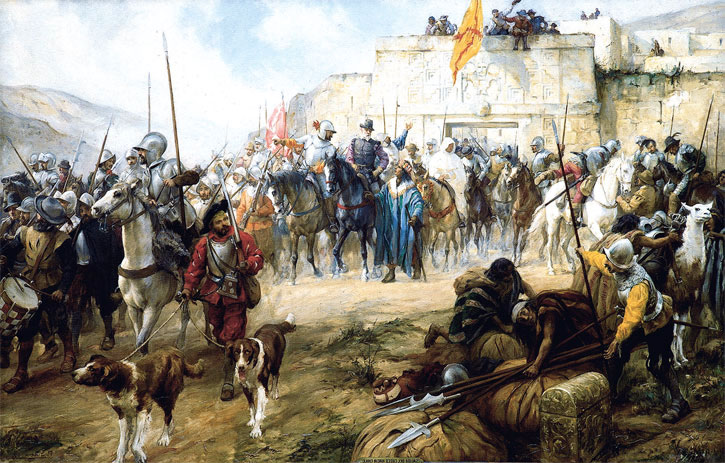
Die Gründung von Santiago von Pedro Lira, 1858 (Wikimedia Commons)


   Demnächst schaffe ich es hoffentlich, meinen Roman Die rote Stadt, endlich zu veröfentlichen, und hier auf dem Blog werde ich eine Serie mit Hintergrundinfos dazu schreiben. Man braucht die Infos natürich nicht, um den Roman zu verstehen, aber vielleicht sind der historische Hintergrund, die Orte, die realen Vorbilder für die Figuren usw. ja auch interessant.
Los geht´s.

    Chile war, zusammen mit Argentinien, eines der letzten von den Spaniern erkundeten Territorien. Die Spanier dürften zum ersten Mal irgendwann in den 1530ern von der Existenz von Ländern weiter südlich gehört haben - teilweise haben sie wohl auch völlig übertriebene Geschichten gehört, die sich später zu Legenden gemausert haben (auf einige davon werde ich später noch eingehen). Haufenweise Gold sollte es in dem entfernten, schwer zu erreichendem Land geben -  Chile ist nach allen Seiten abgeschirmt, im Norden durch die Atacama-Wüste, im Osten durch die Anden, im Westen den Ozean, und im Süden ist ja bereits der Südpol...
    Dennoch unternimmt 1536 Diego de Almagro den ersten Versuch, nach Chile zu gelangen, und zwar über die Anden. Diese Expedition ist kaum anders als Katastrophe zu beschreiben: von den  12 500 Personen, die Peru verlassen haben sollen, kommen etwas über 2 000 im heutigen Nordchile an. Zwar findet dort Almagro bereits zwei Spanier vor, die bei den einheimischen Diaguitas leben und als Übersetzer fungieren können, ansonsten läuft es aber schlecht: die Einheimischen sind feindselig, und Gold finden sie auch nicht. Almagro kehrt nach Peru zurück, wo er sich in Konflikte zwischen Konquistadoren verwickelt und bald stirbt.
Pedro de Valdivia (Wikimedia Commons)
      1540 unternimmt Pedro de Valdivia (links) einen neuen, diesmald erfolgreichen Versuch. Die Überquerung der Atacama-Wüste ist zwar extrem hart, die Spanier verdursten fast, leiden tagsüber unter furchtbarer Hitze und Nachts unter eisiger Kälte, aber gegen Anfang 1541 erreichen sie den südlichsten Rand der den Inkas bekannten Länder. Dort gründet Valdivia im Februar 1541 die Stadt Santiago de Nuevo Extremo (siehe Bild oben, heute Santiago de Chile).
      Die einheimischen Völker wehren sich stark - die Inkas hatten sie ebenfalls nicht unterwerfen können -  bereits im September 1541 wird Santiago fast zerstört. Dennoch geht die Eroberung weiter, die Spanier gründen eine Stadt nach der anderen, zum Beispiel 1550 Concepción, 1551 La Imperial (wo Die rote Stadt spielt) und Valdivia, 1552 Villarica.
      Pedro de Valdivia kommt 1553 bei der Schlacht von Tucapel um,  und die Chroniken überbieten sich gegenseitig bei der Beschreibung grausamer Details seiner Ermordung durch die Indios - auch im Roman wird Jahrzehnte später noch darüber geprochen. Die Eroberung geht allerdings weiter, so wird 1558 die Stadt Osorno gegründet.
     Diese Expansion dauert bis 1598, als ein Zusammenschluss verschiedener Stämme den spanischen Streitkräften eine vernichtende Niederlage beibringt, in der Schlacht von Curalaba am 25 Dezember. Diese Niederlage ist so vollständig, daß die Spanier sich hinter die Linie nördlich des Flusses Bio Bio zurückziehen müssen. Alle Städte weiter südlich, darunter La Imperial, werden aufgegeben, die Insel Chiloe bleibt zwar in spanischer Hand, aber praktisch isoliert vom Rest des Imperiums. Diese Situation ändert sich erst gegen Ende des 19. Jahrhunderts, als die neu entstandene Republik Chile die "herrenlosen" Gebiete im Süden endgültig erobert.
     Die rote Stadt spielt 1595, in den letzten Jahren dieser Expansion, kurz vor dem Zusammenbruch aller spanischer Pläne.
     Denn es dauert nicht lange, bis die Spanier einsehen müssen, daß Chile keine Erfolgsgeschichte wird: die Einheimischen besitzen eine ausgesprochene Kriegerkultur und lassen sich nicht unterwerfen, die versprochenen Goldvorkommen (nach denen in der roten Stadt immer noch gesucht wird) sind so mager, daß sie bald völlig erschöpft sind. Das Einzige, was Chronisten zu Chile lange Zeit einfällt, ist nur, daß dort das Klima wie in Spanien ist und europäische Pflanzen daher ausgezeichnet wachsen....
      Vom 17. Jahrhundert an wird Chile eine ausgesprochen ländliche, ärmliche Ecke, die Weizen, Leder und Talg nach Peru liefert (dies wird sich erst im 19. Jahrhundert durch die Entdeckung und industrielle Ausbeutung von Salpeter in Nordchile ändern).
      Die wirtschaftliche Grundlage bildet dabei die Encomienda: eine für die spanische Krone äußerst preisgünstige Methode der Kolonisation. Dafür werden die im Namen der Krone eroberten Gebiete den Soldaten überlasen, inklusive aller darin lebenden Menschen, natüricher Vorkommen etc. Dabei trug der spaniche "Herr" die verantwortung für seine "Untertanten", für ihr physisches wie seelisches (Bekehrung zum Christentum!)Wohl, und die Krone legte großen Wert darauf, daß es sich theoretisch nicht im Sklaverei handelte. Praktisch war das natürlich nicht zu kontrollieren, und die Lebensbedingungen für die Unterschicht, die sich aus Indios und landlosen Soldaten zusammensetzte,  oft erbärmlich.

das nächste Mal: die Mapuches, Gegner der spanischen Eroberer.

Thursday, 5 December 2019

                                          Mensaje 11/2019


    Uff, espero poder retomar el ritmo (algo) normal pronto....
Pero, mientras tanto, otra colaboración con la revista Mensaje, aparecida en la edicion de Noviembre de 2019.
    Ya he colaborado varias veces con ellos sobre temas de índole cultural, y ha sido siempre un proceso muy ameno, y esta vez no ha sido una excepción.
  El tema está vez ha sido la doble entrega del Premio Nobel de Literatura, al austriaco Peter Handke y la polaca Olga Tokarczuk.
Salió un especie de retrato de la literatura actual de Europa Central, una experiencia muy interesante, también porque conocía bastate poco a Tokarczuk...

Homepage de la revista: www. mensaje.cl 

Friday, 14 June 2019

Fashion Book Friday: Chinese Clothing by Hua Mei


This is my archive of fashion related books. Most of them are in English, but many are not. Some are new, but many are real finds. Depends on the topic, really...

I own several books on "Oriental" influence on Western clothing, but books from Asian countries seem much harder to come by. Chinese Clothing by Hua Mei, published by Chinese Intercontinental Press and Cambridge University Press, as part of Introductions to Chinese Culture, is a rare exeption. A slim volume (a tad over 160 pages), it still manages to pack quite a lot on content, as the chapters are: Ancient Clothing, Clothes and Hierarchy, Silk, the Silk Road and the Art of Embroidery, Regional/Folk Clothing and Modern Dress.
In order to achieve this, the style is very concise and methodical, there are lots of charts and graphs (on the left, a chart to explain the art of Tang-era make up). They explain the evolution of pieces of clothing, make up styles, hierarchical badges etc. All in all, it manages to cover well over two thousand years, at least from the Warring States period to the present day (a helpful chart at the back of the book helps to identify each period in Chinese history), each chapter is concise and clear, illustrations for historical garments, such as the queen from the Five Dynasties Period (10th century) below, are mostly taken from Lady Garments and Adornments of Chinese Past Dynasties by Zhou Xun and Gao Chunming. (This book was edited in the 80s in several occidental languages, and is absolutely brilliant as a source on historical Chinese clothing, with great attention to detail and many different, visual and literary sources. It is also practically impossible to find, I managed to consult it once in a university library. But, Chinese Clothing picks up quite a 

bit of its content and makes it easily accessible).   There is also a short chapter on the Cheong-sam - the "Chinese Dress" on the cover, which, contrary to an opinion currently popular on the internet, is not a "traditional" garment, but rather a fashion style from the 1920s and 30s that fusioned Chinese and Western elements (and has since become a classic).
A lenghty chapter is dedicated to hierarchies, that is, how clothing reflects social structures, and includes court, military and state functionaries´ dress. The unspoken idea behind this is that "fashion" is also reflective of society as a whole, of the underlying order and structures, which contradicts  the popularWestern concept that "fashion" is first and foremost change and things like uniforms are outside of it by definition (But... what do we do if uniforms become "fashionable" or when designers create uniforms? Tricky, tricky...)     

 The chapter of Folk clothes is dedicated mainly to clothing and jewelry worn by numerous minorities in Chinese, and another chapter looks at the importance of the silk trade and the development of the art of embroidery (below is an example of Miao - an ethnic minority in Southern China - embroidery, which the authors consider an example of "a sense of primitive simplicity". Huh. I guess we have different ideas about "simplicity" then)


All in all, this little book will probably not be enough if you, say, want to write a book on Ancient China , but if you need a concise overview or introduction, it probably can´t be beaten. However, if you can get your hands on Lady Garments... , definitely do, it´s superb.

Saturday, 11 May 2019

Fashion Book Friday: Fashion Revivals. From the Elizabethan Age to the Present Day by Barbara Bains


    This is my archive of fashion related books. Most of them are in English, but many are not. Some are new, but many are real finds. Depends on the topic, really...

      One of my all-time favourites, Fashion Revivals is, I think, still an extremely useful and interesting book. While it it too old (edited in 1980) to feature the 21st century´s obsession with all things vintage, it is still unsurpassed in its analysis of the phenomen of "revival" in fashion. Extremely methodical in its structures, it looks at four different types of revivals: 
 Antiquity, that is, all things Greek and Roman; Exotic Revival, everything from far away, the further the better; Rural revival, with rural styles and imagery (on the left, the Duchess of Queensberry pretends to know exactly what it is a milkmaid actually does. And yes, almost all images are in black and white. Pretty normal for a book from that time, but of course a drawback, especially in images such as this, where colour plays a huge role).
The last chapter, Historical revivals, comes closer to what we would consider vintage, but encompasses everything from "medieval" to"what my mum wore".
  Each chapter is then divided by epoch: 16th, 17th, 18th, 19th and 20th century, which allows to show exactly how apparently fix concepts, such as "Greek gods" or "Orientalism" change through time. Because there is a difference when a 16th-century Englishman, who lives in an ambitious, but ultimately insignificant kingdom at the edge of Europe, dresses in Persian dress, dreaming of unlimited (and unavalaible) riches and power, or when a 19th-century British officer dresses in the garb of the conquered "noble savages".
     It might look similar to a casual observer, but political and economical power have shifted so much, and with them the symbolical content of the garments. Similarly complex notions hide behind noblewomen who dress like peasants, or in portrait on the right. It´s Victoria and Albert, dressed as medieval kings. Now, the Victorians had an obsession with all things medieval, as the ideal of a simpler, purer and more truthful age - the Pre-Raphaelites chose "before Raphael" as an ideal for a reason. But, when two monarchs whose power is seriously curtailed by Parliament, dress like kings who considered themselves responsible only to God, there is also a political implication here - it remained without consequence, of course, but the ambition for absolute power is still there.


   While Fashion Revivals is not really a coffee-table book - there is too much text and most images are in black and white and on the smaller side - it is an excellent, in-depth study of the connections between fashion and politics. While there are newer books on some of the topics it covers - I have already reviewed one on Orientalism, there is nothing that I know of, that quite compares in both scope and love of detail.    

Tuesday, 9 April 2019

                                          Revista Mensaje


      Este mes, salió una nueva colaboración mía en la revista Mensaje www.mensaje.cl. Cercana a la Iglesia Católica, publica artículos de interés general desde 1951, eso la hace una de la publicaciones más establecidas en el mercado chileno.
     En realidad esta publicación, de abril 2019, (revista de arriba en la foto) es ya segunda, la primera salió en diciembre de 2018 (revista de abajo en la foto), cuando el blog estaba pausado.

    El artículo de diciembre se dedica a la fantástica Maryse Condé, premiado con el llamado "Nobel Alternativo" el año pasado, y a algunas de sus novelas, vistas sobre todo desde el punto de vista de un lector latinoamericano e hispanoparlante.
   El articulo nuevo está dedicado a algo bastante más triste: este invierno se cumplen 100 años desde la fase más severa de la epidemia de la gripe española en Chile. Revisa cómo llegó al país y qué se hizo para combatirla - lamentablemente nada demasiado exitoso, pues la gripe española (que, por cierto, no originó en España)  es una enfermedad que nunca se logró controlar, simplemente se fue reemplazando por cepas menos mortíferas.

    Como ven, los temas son un poco eclécticos, pero así son mis gustos e intereses, supongo. Y admito que me encanta escribir así, para un público amplio. Un proceder muy diferente de artículos académicos, diferentes maneras de contar y argumentar. Muy divertido, y espero que no sea la última vez.

Wednesday, 27 March 2019

                                 Ein bisschen Inspiration


      Uuund ... ich bin wieder da!!! Den Statistiken nach zu urteilen, wohl nicht wirklich vermisst, aber erstmal geht´s hier weiter.
  Während ich für den fertigen Roman noch einen Verlag suche - und nebenbei mehr über den derzeitigen  Zustand der Bücherbranche erfahre, als ich vorher für möglich gehalten hätte - schreibe ich parallel an zwei anderen. Warum etwas einfach machen, wenn´s auch kompliziert geht ....

      Immerhin spielen sie in der selben Dekade, wenn sie auch sonst wenig gemein haben, und hier sind ein paar Inspirationen, die beim schreiben helfen.
    Die zwanziger Jahre fand ich schon immer faszinierend, so schillernd, so modern und gleichzeitig so fremd und so anders...


      Sozusagen "Stadtführer" für die Epoche. Selbst wenn man die heutige Stadt kennt, sind die Details, die beim schreiben auftauchen, oft ohne Literatur nicht weiter ersichtlich, wie "Wo ging man eigentlich essen/spazieren/feiern/arbeiten?" "Wie war der Verkehr?" "Was für einen Ruf hatten bestimmte Stadtteile?" usw, usw. Solche Details herauszufinden ist unheimlich spannend  und hilft, die Welt der Figure deutlicher "auszumalen". Hier sind also (einige) von mir benutzte Bücher, über jeweils Berlin und Santiago de Chile.
     Da beide Spannungselemente erhalten, muss man sich auch über Polizeistrukturen informieren, über wichtige Protagonisten wie Kommissar Gennat, den technischen Stand der Dinge. Das Buch vorne im Bild, Delincuentes viajeros, erzählt über internationale Mobilität von Kriminellen in Südamerika, und wie die jeweiligen Polizeibehörden dagegen vorgingen.
   Das hier ist etwas Originalmaterial aus der Epoche, sozusagen ganz nebenbei (der in Berlin spielende Roman hat auch etwas mit der Berliner Konfektionsbranche zu tun). Die Deutsche Moden-Zeitung enthält auch Schnittmuster.

Und hier die Modelinie von 1926. Die gerade Linie herrscht noch vor, aber so langsam machen sich weichere, fliessendere Silhouetten sichtbar, gerne mit Drapierungen und Assymetrien. Hier vor allem am Mantel in der Mitte zu sehen.


     Hat noch jemand Lust auf Schokolade nach viel Arbeit?

Tuesday, 30 October 2018

                        María Izquierdo (1902-1955)


        Hoy es el cumpleaños de María Izquierdo. Casi olvidada en la Kahlomanía que inunda el mundo actualmente, durante su vida fue la más conocida - de hecho  fue la primera pintora mexicana a tener exposición individual en Nueva York, en 1930.
 
       Atraía a atención sobre todo de los artistas y críticos extranjeros, que veían en sus colores intensos y sus motivos, tomados directamente de su entorno, la expresión máxima de la mexicanidad en el arte (Autorrertrato arriba de 1940). 
       Nació en Jalisco y estudio arte, como muchos de su generación, en la Academia de San Carlos en la Ciudad de México, donde era alumna, entre otros, de Rufino Tamayo.
       Evoca en sus pinturas los colores, imágenes y las tradiciones de su país natal (arriba, Viernes de dolores, ca 1944) con un orgullo en este universo cultural único, como muchos artistas mexicanos de su generación - en el autorretrato de arriba, se pintó, orgullosamente, como mestiza, en traje tradicional y rebozo rojo.
La mayoría de su obra no es necesariamente muy política, y tanto más interesante es Zapata de 1945, también por su atmósfera sombria y adolorida. Esta tumba solitaria, guardada solamente por caballos, en un paisaje desolado, está lejísimo del patriotismo enérgico que encontramos en tantos murales mexicanos contemporáneos.
Y lo que sí era, fuertemente, era feminista e indigenista. Abogó desde joven por la educación de la mujer, y en muchos de sus cuadros, habla de la situación de las mujeres, y no siempre de la manera más convencional y previsible, como en esta Alegoría de la libertad de 1937, donde la alada libertad aparece casi como una especie de demonio, que lleva en su mano cabezas cortadas de mujeres, víctimas de una modernidad (miren la chimenea de fábrica) y "libertad" crueles, que exigen víctimas. La modernidad del siglo XX no era tan fácil como se pinta a veces.
Sueño y presentimiento de 1947, un cuadro basado en una pesadilla, repite la atmósfera sombria e inquietante de Zapata y Alegoría de la libertad y muestra cómo Izquierdo manipula los medios artísticos. Los colores intensos, los mismos que a los surrealistas europeos parecían transportar una pureza cultural no contaminada, sirven aquí para transmitir una amenaza y angustia lejísimo de la imagen ingenua del "noble salvaje" mexicano.
¿No se merece que la rescatemos del olvido?


Saturday, 20 October 2018

 Fashion Book Friday: The Origins of Italian Fashion. 1900-1945  by Sofia Gnoli


This is my archive of fashion related books. Most of them are in English, but many are not. Some are new, but many are real finds. Depends on the topic, really...

                 Italian fashion really burst on the international scene after 1945 (and boy, do I have books about that!) but this particular little album is all about the decades that preceded it, 1900-1945.


   The first chapter looks at early, rather timid attempts to establish an Italian fashion, independent of Paris, often using motifs from Italian art and history. A lovely early example is the dress  on the left by Rosa Genoni, (Milan, 1906). While it keeps many elements of mainstream fashions of its time: the overall silhouette, the delicate colours, its main inspiration in mood, decoration and details is Boticelli's Primavera, one of the most famous Italian paintings of all time. Genoni tried to both capture a specific "Italian spirit" and establish an independence form Paris.  But for many decades, such designs remained a minority.
 

But much of the early Italian fashion was, in fact, anti-fashion, avangarde that sought to make the idea of fashion change itself superfluous (that´s not how Sofia Gnoli puts it, but hear me out). Both Spanish-born, Venice-working Mariano Fortuny and Roman Maria Monaci Gallenga were highly fashionable, especially among the elites, but their creations did not necessary follow or even take part in current fashion trends. Fortuny found inspiration in the elegant pleats and draperies of Antiquity, while Gallengo recalled Renaissance splendour in her work (opera coat on the right). Both were highly influencial, maybe precisely because they were not actually part of the of the fashion world - rather on the borders between art and fashion.
Similarly, many futurists collaborated whith theatres and fashion designers  - and this books dedicates a whole chapter to these collaborations, with designs by Hiacomo Balla or Thayaht´s illustrations of Vionnet´s dresses. However the most radically piece of futurist "fashion" was Thayaht´s TuTa, a kind of jumpsuit that was first and foremost practical, easy to make and easy to wear, appropriate for all sexes and types of work, and should, therefore , replace the superficial vanity fair of fashion. (The TuTa itself is not in the book, the image below is taken from the Museo del tessuto in Prato).


    Other major influences are the incomparable Elsa Schiaparelli (left) and Salvatore Ferragamo. While both spend large and most important part of their carreers outside of Italy (Schiaparelli worked in Paris and Ferragamo - inventor of the wedge heel - started out as a "shoemaker to the stars" in Hollywood), their fame and creativity helped to create a positive image of Italian fashion long before the local industry was capable of fully backing up that claim. The book looks at their work in quite some detail.


      A very important part of the book is dedicated to fashion within the political context of that time. Some aspects include the fascist regime´s attitude towards not just fashion, but feminity in general - an attitude not free from contradictions, as it propagated both a conservative, catholic worldview and the fascist ideal of a strong, physically active, sporty woman at the same time. 
     Quite another topic was self-sufficiency in terms of textile production (many of the countries involved in WWII had similar problems). This problem was in part solved by a strong rise in the artificial fibres production, but still, rationing had to be introduced by 1941. The image below shows a detail of a wartime dress: made with artificial "silk" fibres and with dressmaker´s skill in elegant details compensating for the limited fabric availability. Many companies that later achived worldwide fame started out in this atmosphere of limited means and a hightened need for creativity- Gucci, Fendi...


Friday, 12 October 2018


 Fashion Book Friday: El hilo conductor. Tradición y moda en el Perú (The Guiding Thread. Tradition and Fashion in Peru) by Olga Zaferson Aranzaens


This is my archive of fashion related books. Most of them are in English, but many are not. Some are new, but many are real finds. Depends on the topic, really...

I found this little jewel in a random bookshop, and felt quite lucky, as fashion in Peru doesn't seem to be a big topic (and I'm always interested in fashion outside of the big centres of the industry). 
Encontré esta pequeña joya en una librería cualquiera y me sentí bastante afortunada, ya que la moda en el Perú no parece ser un gran tema (y siempre me interesa la moda alejada de los grandes centros de la industria). 
    The accent here is very much on tradition, as it seems to be the author's expertise. There are chapters on prehispanic technique of spinning, weaving and dyeing and their survival in Colonial times. Quipus (left), the still undeciphered Inca "recording device", made with knots on series of strings and some spectacular jewelry are also featured. Her sources here are Colonial age- texts and illustrations, contemporary photos of women working with traditional techniques and  arqueological finds.
El acento aquí está claramente en la tradición, la que también parece ser el área de especialización de la autora. Hay capítulos sobre las técnicas prehispánicas de hilado, tejido y teñido y su supervivencia en la época colonial. También hay textos sobre los quipus (arriba), el "dispositivo de grabación" Inca y que está aún sin descifrar, ralizado con nudos en grupos de cuerdas, y alguna que otra joya espectaculare. Sus fuentes en esos capítulos son textos e ilustraciones de la época colonial, fotos contemporáneas de mujeres que trabajan con técnicas tradicionales y hallazgos arqueológicos.
 Other chapters are dedicated to garments and traditional styles, the most famous being, without a doubt, the "tapada limeña", the "covered women from Lima": women in Peru, especially in Lima, wore until the early 19th century a long, dense, black veil (see the statue on the right). As bizarre as that may look, the resulting anonymity actually meant greater freedom of movement for women, as it also meant they were free from social control and vigilance. This particular style only disappeared after the Independence and arrival of French fashions.
   
Otros capítulos están dedicados a prendas y estilos tradicionales, siendo el más famoso, sin lugar a dudas, la "tapada limeña": las mujeres en Perú, especialmente en Lima, usaron hasta principios del siglo XIX velos negros y tupidos(ver la estatua a la derecha). Por extraño que parezca, el anonimato resultante en realidad significó una mayor libertad de movimiento para las mujeres, ya que también significaba que estaban libres de control social y vigilancia. Este estilo particular solo desapareció después de la Independencia y llegada de las modas francesas.


 Then she looks at the survival of traditional garments and techniques in the different parts of Peru, a colourful array of amazing shawls, hats, skirts, ponchos... (on the left an amazing example of shipiba embroidery) . A glossary completes the description and helps to avoid confusion.
    Luego, observa la supervivencia de las prendas y técnicas tradicionales en las diferentes partes del Perú, una lluvia colorida de increíbles chales, sombreros, faldas, ponchos ... (a la izquierda, un impresionante ejemplo de bordado shipiba). Un glosario completa la descripción y ayuda a evitar confusiones.


The last chapter, Fashion, is also the weakest, for several reasons. The author seems to understand "Peruvian Fashion" mainly as "Folk Fashion", which of course must end up a bit lop-sided and incomplete... There is an interesting selection of what seem to be runway photos (left) but sadly she fails to identify the respective designers. A pity, because the use of traditional techinques in those garments is often innovative and visually attractive. Oh, and John Galliano's name is misspelled, an error that slipped past all editors...

 El último capítulo, La moda, es también el más débil, por varias razones. La autora parece entender "Moda peruana" principalmente como "Moda folklórica", que por supuesto debe resultar un poco incompleto ... Hay una interesante selección de lo que parecen ser fotos de pasarela (izquierda), pero lamentablemente la autora no nombra a los respectivos diseñadores. Una pena, porque el uso de técnicas tradicionales en esas prendas es a menudo innovador y visualmente atractivo. Ah, y el nombre de John Galliano está mal escrito, un error que se escapó a todos los editores ...


Overall, and in spite of one weakish chapter, an amazing, very informative book and a great addition to any costume library. 
En general, y a pesar de un capítulo algo débil, un libro asombroso, muy informativo y una gran adición a cualquier biblioteca de historia de traje.
ISBN is 978-9972-894-67-1


Die rote Stadt Zusatzinfos, Teil 8: Die Cäsarenstadt Expedition von Almagro in Chile v. Pedro Subercaseaux. wikipedia       In ...