Friday, 31 August 2018

      Fashion Book Friday: Men in Black by John Harvey

This is my archive of fashion related books. Most of them are in English, but many are not. Some are new, but many are real finds. Depends on the topic, really...

    Here is another find from Brazil, so, while it was originally written in English, my edition is in Portuguese.
     Menswear usually takes a backseat in fashion studies, and rarely makes it out of the general introductory type of book. Which makes this little gem all the more special.
     It is almost entirely dedicated to menswear, to the preponderance of black in male clothing, to be
 precise.
   John Harvey looks at how the nineteenth-century gentleman dresses himself almost entirely in black, at a time whe women prefer strong or bright  colours (such as in this scene by Renoir) and follows the "biography" of Black since the Middle Ages (when it meant  renouncing rather than following fashion)  into the Renaissance, when it went mainstream for the first time in different, rather contradictory contexts: at the (very Catholic) Spanish court, where it came to symbolise serenity and sobriety, and among the members of the new Protestant creed, where it came to mean virtue and renouncing of vanity. Both dressed black from head to toe, if from different motivations. Both intellectuals and the new, rising merchant class favour black, to distinguish themselves form courtiers and peasants (below Thomas Cromwell, his fur collar and gold ring hint not-so-subtly that black does not have to be humble at all).
     Richly and extensively sourced and illustrated, Men in Black is actually a cultural history of the colour black in Europe in the last 600 years or so. John Harvey looks at Chaucer, Shakespeare, Ruskin and quite extensively at Dickens, and illustrates his findings with a beautiful collection of images, mostly portraits, but also genre scenes and book illustrations. Othello and Dickens´s Victorian gentleman are followed by twentieth-century wearers of black, who are at least as contradictory as their Renaissance counterparts: Fascist organisations (called Blackshirts for a reason) prefer black (or similar dark colours), but also do countercultures, where the lack of colour, symbolised by black, becomes the essence of rebellion (Marlon Brando in the photo below, illustrates this very well).

   Superbly written, with a great sense of humour, an unique perspective on a little written-about topic, especially outside of academia, it is actually one of my favourites. Only if the pictures where a little clearer. I don´t know if it is a problem of this particular edition, but the otherwise excellent illustrations are relatively small, black and white and slightly blurry... A pity, really.

Monday, 27 August 2018

                    Dorothea Tanning (1910-2012)

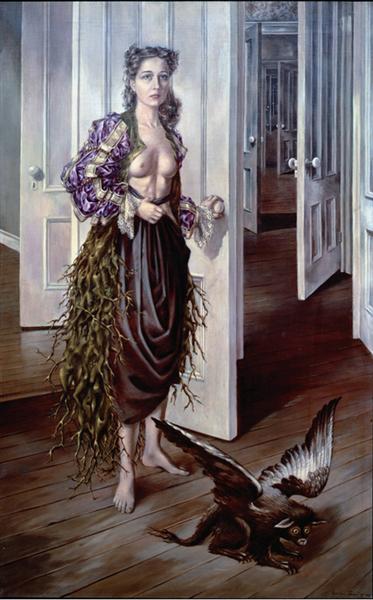
Birthday. 1942
    Dorothea Tanning´s birthday was, in fact, this past Saturday, August 25. She produced some of my favourite paintings and it´s a pity she isn´t better known. (Also, since The Guardian claimed rather bizarrly in a recent article that Lee Miller was the "lone woman within the surrealist scene" I guess I`ll be posting about some of them here. Lee Miller is amazing, her photography hypnotising and moving, but there were literally dozens of women involved in some degree with the "surrealist scene". Rant over.)
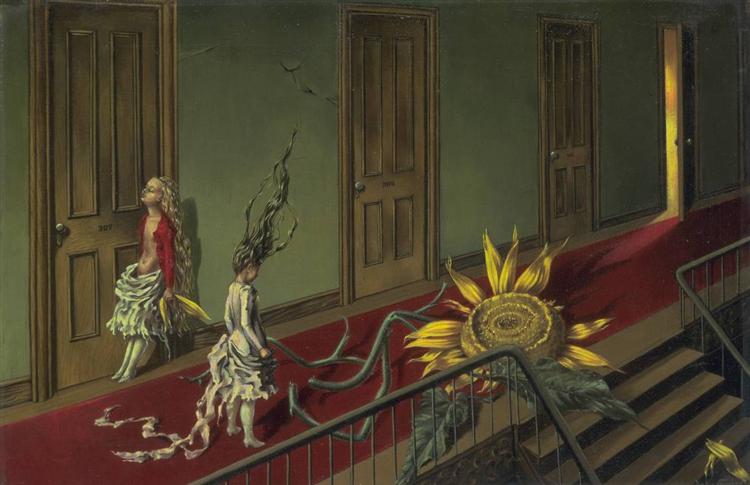
Eine kleine Nachtmusik. 1943
       The paintings above are from the mid-40s, her first splash of popularity when she lived and worked in New York (she was born in Galesburg, Illinois, which according to Wikipedia had about 22.000 inhabitants at the time). Both are typical of the mood in her art at the time, dreamy, suggestive, an illusion of soft, undulating movement about to leave the frame.
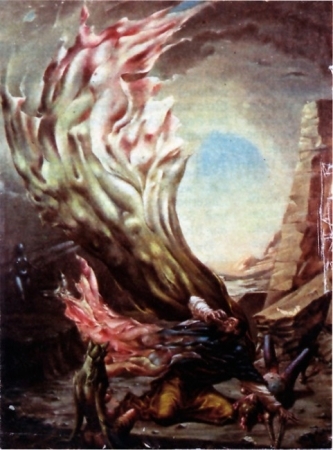
The Temptation of Saint Anthony, 1945
It was also there that she met her future husband, Max Ernst,  who introduced her "officially" into the surrealist group. The pair later moved to Arizona and then to France. They remained married until Ernst`s death. The painting on the left was her contribution to a Hollywood artistic competition for the otherwise unremarkable The Private Affairs of Bel Ami. Many contemporary artists took part, among them Ernst, Dali, Paul Delvaux or Leonora Carrington (Ernst won).
    In later decades, her paintings became increasingly abstract, although she always maintained the same aura of sensuality and an elegant, almost suggestive palette.

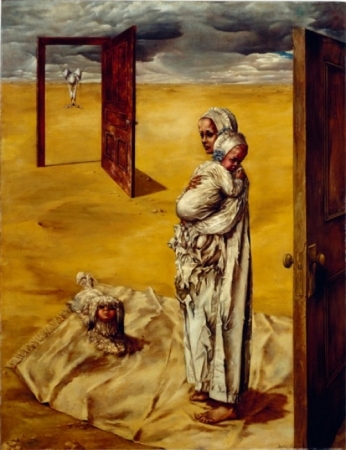
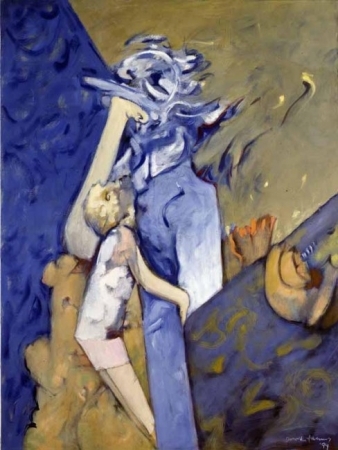
Below are two of her paintings on the same topics, motherhood, that show her evolution quite well: Maternity from 1946 on the left and Blue Mum from 1994 on the right


Friday, 24 August 2018

Fashion Book Friday: O espiritu das roupas. A moda no século dezenove. (The Spirit of Clothes. Fashion in the Nineteenth Century) by Gilda de Mello e Souza


This is my archive of fashion related books. Most of them are in English, but many are not. Some are new, but many are real finds. Depends on the topic, really...

I bought this little book on a whim on a holiday in Brazil, and I´m very glad I did. While there are no great names, no celebrities or famous designers on its pages, the concept of fashion it offers is both unique and insightful. The author, a philosophy and literature professor from Brazil, treats fashion as a minor art (one chapter is actually called "Fashion as Art") that reflects and takes part in architectural, social, economical developments of the society it exists in (picture below)

       She looks at how fashion defines divisions of gender and class, always following the newest
technological developments, how fashion effectively becomes an expression of a "female culture" - at the same time as women are expulsed from the public and working spaces, defined by then as exclusively male, and men claim to lose all interest in "fashion" (the slower pace of change in male clothing, loss of all colour from male dress etc - at the same time as technical progress made more and new colours available for the textile industry).  Fashion, or the indulgence in it, functions here also as a signifier of social and economic inequality between the sexes (see illustration on the left). Quotations from contemporary literature, mainly Machado de Assis,  support her theory. 


The book´s focus is mostly on international fashion, but as an uniquely Brazilian example, she looks at rich provincial landowners, and how their attitude to clothes changed: throughout most of the century, wealth was never shown through clothes or furniture (the couple on the left, ca. 1870), even if the fortune, consisting of land, cattle and (until 1888) slaves. The latter couple, ca 1900, belong to a generation that begins to flaunt their wealth through clothing and generally consumption, a general change in attitudes.
Mind you, this by no means a coffee table books. Although there is a whole gallery of pictures at the back, they are all black and white, sometimes even grainy, as if gone through too many photocopiers (first edition was in 1987). In fact, my only peeve are the pictures: while there is an extensive and excellent annotations corpus in the book, I didn´t find a list of illustration, and the captions themselves are unhelpful, especially in the case of painting.
Still, if you like to read an analysis of fashion on the crossroads between aesthetics and social issues, this is the book.  Pity it hasn´t been translated apparently.
The ISBN is 85-85095-24-5

Friday, 17 August 2018

Fashion Book Friday: Schulze-Varell. Architekt der Mode (Schulze-Varell. Architect of Fashion)


This is my archive of fashion related books. Most of them are in English, but many are not. Some are new, but many are real finds. Depends on the topic, really...

Fashion is a curious business. We all participate in it to some extent, as we all need to dress, there are constantly new things in the shops, but this same activity and hectic often implies the memory span of a fruit fly. As soon as something is out of the shops, it might as well as not exist, and former prodigies are completely forgotten. This week´s book is about such a forgotten prodigy, the German Heinz Schulze-Varell.
Mode ist ein kurioses Ding. Wir sind alle zu einem gewissen Grad daran beteiligt, wir brauchen ja alle Kleidung, es gibt ständig neue Dinge in den Läden, aber die gleiche Aktivität und Hektik hat oft das Erinnerungsvermögen einer Fruchtfliege zufolge. Sobald etwas aus den Läden verschwindet, ist es, als ob es nie existiert hätte, und ehemalige Wunderkinder sind völlig in Vergessenheit geraten. Dieses Buch handelt von einem so vergessenen Wunderkind, dem Deutschen Heinz Schulze-Varell.
       Born in Berlin, he started his career at Hermann Gerson, easily the poshest, most exclusive fashion house in Berlin (more books on Berlin in the Twenties to come!), where he also met, and later
the glamourous couple
 married, Margarethe Kickler, called Kiki, granddaughter of architect Ernst Bandel (best known for this ). She was a fashion illustrator, a much more glamorous profession at the time than a model, and became her husbands muse/model/dressform.

       Geboren in Berlin, begann er seine Karriere bei Hermann Gerson, dem wohl vornehmsten und exklusivsten Modehaus in Berlin (weitere Bücher über Berlin in den zwanziger Jahren kommen noch!), wo er auch Margarethe Kickler, genannt Kiki, kennenlernte, die er später heiratete. Enkelin des Architekten Ernst Bandel (am besten bekannt für das Hermannsdenkmal). Sie war eine Modeillustratorin, damals ein viel glamouröserer Beruf als Modeln, und später wurde sie für ihren Mann Muse / Model / Schneiderbüste.

       Later, he worked for Gerson´s competitor, but after the Nazis came to power, his Jewish boss was forced to give up his business, and Schulze-Varell opened his own salon in Berlin (he had apparently been offered to buy his former employer out for cheap, as the so-called Aryanization, but refused. He said it felt like grave robbing.) He quickly became established as an elegant, does-not-just-copy-Paris address in Berlin, but this in itself brought problems: he was not a Nazi sympathiser, but neither was he prepared to leave everything behind and go in exile. A difficult balance was needed, avoiding demostrations of party loyalty or dressing the
Art Deco chic, 1934
wives of the new Nazi elite, but at the same time not doing anything that might seem provokative. It didn´t always work, he very narrowly avoided being sent off to Stalingrad as a punishment for insubordination, but protection from film stars (who, in turn, were key to the Nazi propaganda machine) helped him stay in Berlin until the end of the war.
       Später arbeitete er für Gersons Konkurrenz, aber nach der Machtergreifung durch die Nazis musste sein jüdischer Chef sein Geschäft aufgeben, und Schulze-Varell eröffnete seinen eigenen Salon in Berlin (anscheinend war ihm das Geschäft seines früheren Arbeitgebers im Rahmen von "Arisierungsmaßnahmen" billig angeboten worden, aber lehnte ab. Er sagte, es käme ihm wie Leichenfledderei vor). Er etablierte sich schnell als eine elegante, Kopiert-nicht-bloß-Paris-Adresse in Berlin, aber das brachte wiederum Probleme: Er war kein Nazisympathisant, aber er war auch nicht bereit, alles hinzuschmeißsen und ins Exil zu gehen. Das erforderte eine schwierige Balance, einerseits, um die Loyalitätsbekundungen zu vermeiden oder den Frauen der neuen Nazi-Elite auszuweichen, aber gleichzeitig nichts zu tun, was die Machthaber zu sehr reizen könnte. Es funktionierte nicht immer, um ein Haar wäre er als Strafe für Ungehorsam nach Stalingrad eingezogen worden, und nur die Protektion von Filmstars (die wiederum eine Schlüsselrolle in der Nazi-Propagandamaschine hatten) half ihm, bis zum Ende des Krieges in Berlin zu bleiben.

  After the war, he re-opened in Munich. The picture on the left is an example of the first post-war collections: warm, and made out of whatever was at hand, in this case, uniforms (uniforms were actually banned by the allies, but seeing the general shortage of clothing and fabrics, they ignored civilian clothing made out of uniforms (or even flags), as long as all Nazi insignia had been removed). He remained in Munich until his death in 1985.

 Nach dem Krieg öffnete er sein Salon in München wieder. Das Bild links ist ein Beispiel für die ersten Nachkriegskollektionen: warm und aus dem gemacht, was gerade zur Hand war, in diesem Fall Uniformen (Uniformen wurden eigentlich von den Alliierten verboten, aber wegen des allgemeinen Mangels an Kleidung und Stoffen  ignorierten sie  aus Uniformen (oder sogar Fahnen) gefertigte Zivilkleidung, solange alle Nazisymbolen entfernt worden waren). Er blieb bis zu seinem Tod 1985 in München.


The book, however, in not particularly heavy on text, it is rather a catalogue of his work from the earliest designs under his own name, such as the dress above, to the sketches for his last collection 1985, the year of his death. Some examples are below. 
 Das Buch  ist  jedoch nicht gerade textlastig, es ist vielmehr ein Katalog seines Werkes, von den frühesten Entwürfen unter seinem eigenen Namen, wie das Kleid oben, bis zu den Skizzen für seine letzte Kollektion 1985, seinem Todesjahr. Ein paar Beispiele unten.
Experimental 50s design: wool fringe cape.


evening gown, 1962


sketch from his last collection, 1985

flower child, 1972 (the flowers are red plastic)


It is very much out of print (edited in 1991) but if you want to try your luck, the ISBN is 3-925835-86-5.  
Es ist natürlich vergriffen (herausgegeben 1991), aber wer sein Glück versuchen möchte, die ist ISBN 3-925835-86-5.

Friday, 10 August 2018

Fashion Book Friday: Chanel. The Couturiere at Work by Amy De La Haye


This is my archive of fashion related books. Most of them are in English, but many are not. Some are new, but many are real finds. Depends on the topic, really...

       When I was looking for a book about Chanel, I wanted one that would concentrate specifically on Coco´s work (rather than on the entire House of Chanel) and this book, first published in 1995, turned out to be just it. 

  It begins by tracing whatever little is known about her childhood and her beginnings in the fashion business. While today she is mainly associated with the roaring twenties, she in fact open her first shop (with financial help from her lover) around 1908 and quicky became known as the purveyor of excentrically, even radically simple hats and later clothes. The cartoon on the left is from 1914 and gives an idea about her popularity (and reputation) before the Great War. 
    She went main stream around 1917, when her simply cut, made with simple materials, jersey suits, sold in boutiques in sea side resorts, first Deauville, later Biarritz, hit the nerve of the times and her designs began appearing in fashionable magazines in Europe and America.  


     In the following decades, Coco became one of the biggest designers in France and her clothes, while still simple in their overall style, began using luxurious materials, such as furs, silks, laces or hand embroidery, that often covered the entire surface of the dress. She also launched her first (and still most popular) perfume, Nr 5, in collaboration with the incredibly talented Russian-French perfumer Ernest Beaux. An exclusive line of fake jewellery followed (she is wearing several pieces in the photo on the right), it was the first time that a designer managed to give fake jewels the same prestige real ones would have. In those busy years, she also began collaborating with theatre (in the picture below are her wonderfully archaic looking costumes for Jean Cocteau´s version of Antigone) and Hollywood, although she only made costumes for three movies, as she reportedly felt too
constrained by the working conditions she encountered (such as actresses refusing to be told by her how exactly to dress, and she herself refusing to follow the actresses´ lead).
    The simple lines of twenties´ fashion meant it was easy to mass produce copies (something the Chanel herself encourages rather than blocked), so that she quickly became a household name to people who would never be able to afford a Chanel original, but gladly bought a copy.
   All was not well, however. Apart from her style or glamour, Chanel was also (in)famous for low pay and bad working conditions - she even was reported to say that her "girls" could always get themselves lovers if they wanted more money. So, perhaps unsurprisingly, her house was rocked by a massive strike in 1936. She intially refused to accept the demands, but finally relented after it became clear that otherwise she might not be able to produce and present the next collection.
  Technically, Chanel was not "at work" between 1940 and 1953, so this books deals with this entire period in a few sentences - so, if you are interested in the often discussed question of her assumed collaboration with the Nazis in occupied Paris, you won´t find anything here. 
      Her return in 1953 produced her probably most famous piece, the "Chanel suit" (on the right), that has since been produced in hundreds of variations, thousands if you count the copies. The revolutionary character of this relaxed yet luxurious outfit becomes clear if you compare it to the hyper-feminine creations presented at the time by her (male) colleagues like Christian Dior or Marcel Rochas (Rochas is already on this blog, Dior is coming up). She mantained an iron grip on her house until her death in 1971 and became probably the most famous name in fashion in her century, even when her creations were becoming rather something for the "mature set" - Chanel famously rejected both the miniskirt and pants for women. It remained a task for her successor, Karl Lagerfeld, to integrate pants into the Chanel look.   
 The final chapter looks at how Lagerfeld kept her signature style always up to date through the 80´s and 90´s, using new materials, like jeans or leather, or cuts - trousers, shorts, tops. It always remained very much Chanel (on the left, Nadja Auermann models a "versacefied" early 90´s version).


So, if you are interested in Mademoiselle herself and can accept a rather cursory look at Karl the Great´s work, this is definitely worth it.


Monday, 6 August 2018

                                                 Ilya

   
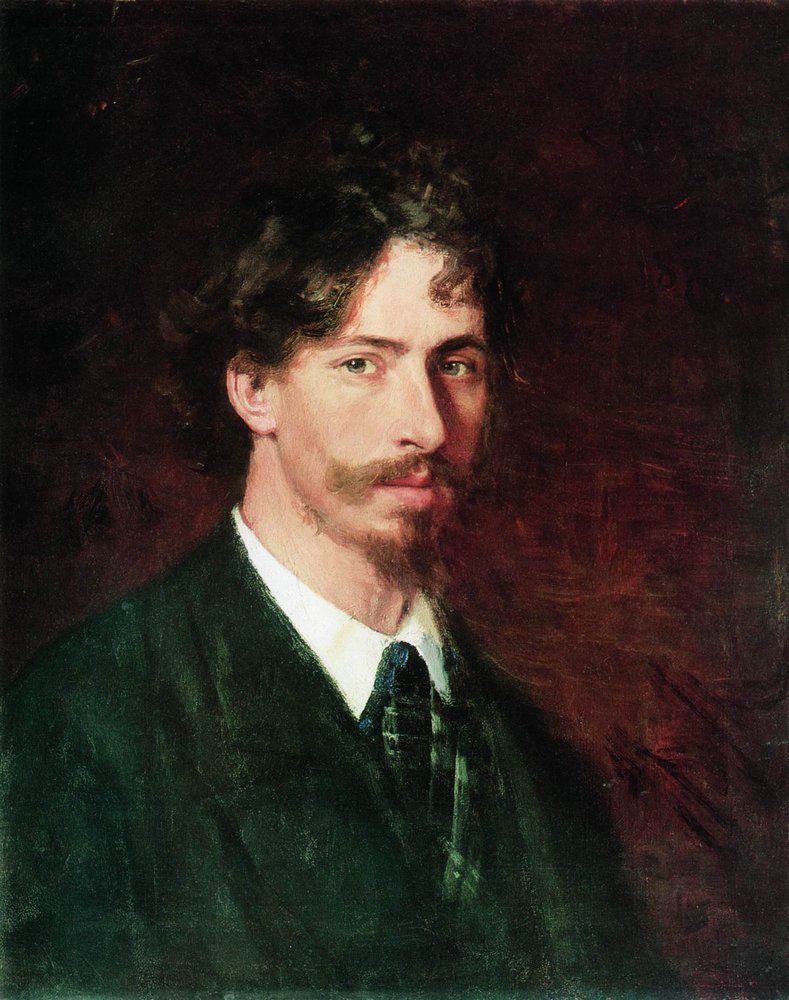
       Sorry for the long silence, things got in the way. Anyway, yesterday was the birthday of Ilya Repin (1844-1930), so why not write a post about him. After all, even if you are not terribly interested in Russian art (especially if you are not), his paintings are probably the ones you might have seen anyway (all sources: Wikimedia).
This for example
   And although his paintings made him famous almost immediately, they also almost inevitably caused a scandal. Barge Haulers on the Volga (1870-73) caused a sensation for depicting a "vulgar" a "low" subject matter in a monumental, "epic" setting, although it did strike a nerve and became the foundation of his career as a painter.
or this.

Ivan the Terrible and His Son Ivan on November 16th, 1581 (1885) on the other hand, is easily the most scandalous painting in Russian history. Developed and painted under the impression left by the assassination of Tsar Alexander II in 1881, it shows the moment after Ivan the Terrible killed his own son in a fit of rage, the tsar cradling the dead body of his eldest child (while we have no actual documental proof of how exactly the prince died, there are many contemporary records, both Russian and by foreign diplomats, that show that there was in fact a rumour in Moscow that the Tsar had killed his own son with a blow on the head). The bloodied image of the dead prince and the scared, crazed expression on the tsar´s face caused such a shock with contemporary audiences that it was immediately officially prohibited by tsar Alexander III, even if only for a few years. It has since become the favourite hate object of different conservative groups - who believe that it demeans royal, and therefore state, authority, and it has repeatedly been vandalised - the last time just this year.

   Although Repin is best known for his historical and genre paintings, he also excelled at portraits that captured the sitter´s grace, individuality and emotional state, such as this portrait of  the composer Modest Mussorgsky, painted just a few days before his death in 1881. His glance, attentive and intelligent in spite of the visibly grave illness, somehow shows his unique sensibility more than any photography ever could.


I have to admit though that my favourite painting is this: Sadko (1874). Painted as a reaction to the impressionists, whom he found technically interesting but lacking substance, it shows a scene from the legends about Sadko, a Sindbad-like character. Sadko, a sea merchant, winds up at the Sea Kings´s court, and observes a procession of the court ladies. Funnily enough, some critics found that Sadko, too, was lacking substance, narrative or artistic, but for me, this painting is pure magic. Seen "live", it does indeed give the impression of being under water, a sensation completely lost in reproduction, and standing in front of it, you do feel transported for a moment into this magic dimension, that feels so real and at the same time so phantastic. Art not even trying to imitate life, rather inventing its own dimensions of meaning.

Friday, 20 July 2018

Fashion Book Friday: Orientalism. Visions of the East in Western Dress by Richard Martin and Harold Koda

This is my archive of fashion related books. Most of them are in English, but many are not. Some are new, but many are real finds. Depends on the topic, really...
    So, in the last few years I´ve developed an interest in fashions outside of the great metropolis, and luckily, there is a growing number of books on such topics. This one in particular is about the influence of "the Orient", that is, a number of Asian cultures, on Western dress - so it looks in just that one direction, books on non-Western clothing and culture coming up.
       

     It covers a bit over three centuries, from the late 17th to the late 20th, and is divided into chapters: China, India, Near East and Middle East, Japan and Southeast Asia, although the authors explain the "Orient" is often enough a mixture of several cultures moulded onto Western conventions. It is of course eye candy, chock-full of splendid 18th century court dresses and designs by Chanel, Versace, Valentino, Yamamoto, but the text is simply fascinating, tracing parallels between dress and social, economical  and political developments. Both colonial expansion and the longing for a different, somehow magical world supposedly found in faraway countries played a role. An example: the banyan, an 18th century male Western garment of vaguely Indian origin, stands in the beginning of informal clothing in Europe, and the distinguished gentleman´s favourite garment for portraits - so much so, that Samuel Pepys borrowed a banyan for his portrait above, as a sign of cultured luxury, status and leisure.
      Throughout the 19th century, the - authentic- Cashmere shawl became a byword for luxury, they were inherited, cut up and resewn into Western garments when shawls became outdated, creating a completely knew Fashion mix. They were also copied by European manufacturers, pushing the more expensive originals out of the market.
For others, the East became a symbol of resistance and fight: when Lord Byron (on the left) wears Balkan-style clothing, he shows his participation in the independance movements in this region in the 19th century, particularly Greece. Something similar happened later with the Mao suit, Nehru jacket or hippies´ clothing. In all those cases, the Orient is the better other of the West, where Western taboos and restriction don´t exist.
     Colourful clothes for men and more relaxed, less restricting cut for both sexes entered Western fashion often enough through the designers´ interest in "Oriental" techniques like draping or tying, both by Westerners with interest in Asian cultures, like Valentino, or Asians working in Europe or the US, like Issey Miyake. The presence of the often symbolic Orient widens Western aesthetic and cultural limits, although it can be a delicate balance, never quite free from political of economical implications of (post) Colonialism, something the authors also briefly discuss.


  Orientalism is both lovely to look at and though-provoking, and it makes a nice companion to books on more typically academic topics, say  Edward Said´s Orientalism, to understand the intricate connexion between clothes and politics. At any rate, the beauty and creativity of these "hybrids" is unique, such as in these poetic Hanae Mori dresses.

The book is technically out of print, but, since the Met makes some (sadly not all) of its out-of-print publications available for free on the web, it is available as a free PDF here.

Friday, 13 July 2018

Fashion Book Friday: Marcel Rochas. Designing French Glamour by Sophie Rochas

This is my archive of fashion related books. Most of them are in English, but many are not. Some are new, but many are real finds. Depends on the topic, really...

Almost forgotten today, Marcel Rochas was nonetheless one of the most important couturiers of the mid-twentieth century, in large part responsible for the iconic image of the enigmatic, impeccable French feminity. With this book, by his daughter Sophie, he finally has the splendid volume he deserves. 
   

        It is richly illustrated, with a mixture of close-ups of clothes, contemporary fashion photography and pictures from the family archive, like the ones on the right, and those latter distinguish this book form so many others. It is certainly not rare to find a fashion book, even a coffee-table picture collection, driven by an endless love of fashion, attention to detail and perfectionism, but finding a book that at the same time breathes intimacy, that speaks not only of the master of fashion, arbiter of taste etc, but also of the brother, son, husband, father, friend, or even simply the private person that enjoys a weekend in the sun.
Sophie Rochas mixes her private memories of her parents (her mother Hélène was her father`s favorite model and muse) with chapters on marketing, her father`s work for the cinema (he opened a division dedicated to working with film and dressed many French stars, such as Jean Marais) or his iconic perfume Femme (launched 1945 and still available after over 70 years).


  Sophie also cronicles his progression from jazzy, stream-lined fashion of the Twenties, to the elegantly dramatic gowns of the Thirties that show a clear influence of surrealism, such as his famous Bird dresses (one of them is featured in the picture on the left) to the mature, almost uber-feminine, yet never cloying, gowns of the postwar period. Gala gowns, smart suits, hats, underwear, swimwear, perfume...  The Rochas woman, best personified by his second wife Hélène, rises from these pages like some phantom of absolute beauty, and while leafing through it, I felt the wonder Sophie described when, as a little girl, she saw her mother transform into this beatiful creature at the hands of her father.
    At the same time, she describes enough of the backstage work to have a glimpse of how this illusion of unearthly beauty came about: she includes the memories of people who worked with her father, describes working and living conditions in occupied Paris (Rochas was one of the houses that decided to stay open during occupation), especially the fight of the couturiers to not let themselves be controlled by German forces. This might sound trivial at first, after all, it`s just the luxury segment of the rag trade, but by then, the fashion industry had become synonymous with France, of great economic importance, and the Germans were very much interested in controlling it and ideally transporting it to Berlin, which was to become the new centre of everything, including fashion (ironically, they were at the same time  destroying the actually vibrant fashion industry in Berlin, apparently "too many Jews" were involved, but that`s for another occasion). It was therefore a great achievement of the French fashion industry, lead by Lucien Lelong, to remain independent .
Apart from designers and models, friends and customers of the glamourous couple appear on the pages, many actors, but also Evita Perón, wife of the Argentinean president, whose life was later turned into a musical (Evita), and, first and foremost, the painter Leonor Fini, who was apparently a close friend. I have to admit I had no idea, and seeing both photos of and paintings by (above) my favourite painter was a particularly pleasant surprise.
And to finish, this statement by Rochas. I´m not saying this is the last word on the topic, but it is a captivating observation on different attitudes of male and female designers when it comes to dressing, and ultimately treating, the female body.


Friday, 6 July 2018

Fashion Book Friday: Russkaya moda. 150 let v fotografiyakh (Russian Fashion. 150 Years in Photos) by Alexandr Vassilyev

This is my archive of fashion related books. Most of them are in English, but many are not. Some are new, but many are real finds. Depends on the topic, really...

     This is one of those books that took me years to find, after leafing through them in a library (Btw: the picture above is the "mini"Version, which is what I have. The book in the foto is the original, large-format version. The content is the same, as far as I can see) .
The author, Alexandr Vassilyev, is currently one of the major experts on the history of fashion in Russia, a one-man Costume Institute, and this book is incredibly thorough. Since its focus is on fashion through photography, it begins in the 1850, so nothing from Pushkin`s age, but after that, it runs the full gamut from frothy salon beauties to edgy post punk styles


It´s organized by decades and each decade in turn in women´s, men`s and children´s fashions, so it is very methodical and easy to work with. Pictures of royalty, music and film stars, revolutionaries, soldiers and many anonymous people parade on its pages, showing effectively how fashion reflects a country`s history. In his text, Vassiliev also always establishes connexions between what people wore and what social, political and economical upheavals they lived through.
These young ladies wear dresses made out of priests´ clothing, as much of the nation´s industry collapsed during the civil war, and the textile industry was not a priority for the new government.
The late fifties brought a change in attitudes, an international youth festival
 for the first time in decades brough foreigners into close contact with soviet citizens, and Dior made a fashion show on the Red Square (picture on the right).
     The situation with the availability of clothing a fashionable goods improved somewhat, though it was still far from great. The author tells about the role smugglers and importers of foreign goods played, and how effectively class divisions remained visible through clothing: access to imported goods, access to (very expensive) "Fashion Houses" where made-to-measure was available for the elite. Smaller ateliers were available to the middle class in bigger cities, still quite expensive, as off-the-rack remained a bit underwhelming throughout the existence of the Soviet Union.
   But in these relatively prosperous times, a new, less agressive female ideal became established, so most soviet women found themselves somewhere between those two:


Valentina Tereshkova, first woman in space
Irina Miroshnichenko, actress

Another lovely detail of this book is that, since it includes a lot of everyday clothes, some hard to find items are also here, such as early knits:
one is this surprisingly modern looking shawl from the 1880s. What looks like eyelash yarn is actually swan down.

or this toque and scarf set from the 30s

or this lovely early 70s hippie


Overall I love this book, both eye candy and a detailed, thorough read, a different way to understand history and changes in norms and attitudes - one of the reasons I love the study of fashion history so much. Just a pity it´s so hard to come by. In any case, the ISBN is: 978-5-387-00115-4 


Die rote Stadt Zusatzinfos, Teil 8: Die Cäsarenstadt Expedition von Almagro in Chile v. Pedro Subercaseaux. wikipedia       In ...